Off The Page And Onto The Streets – A Reflection On The Beatitudes

Published by

on

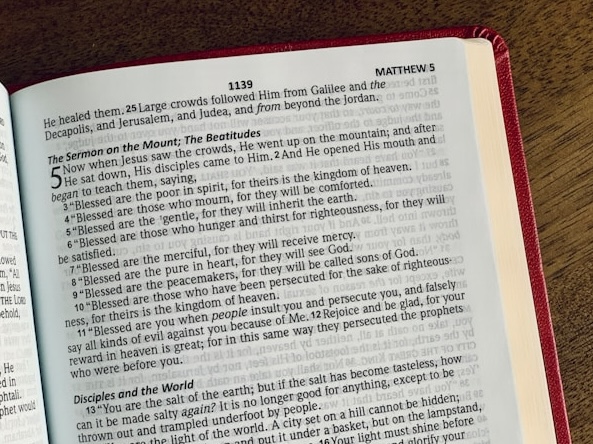
Every day I receive emails, texts, and news articles calling me to act, to resist, to protest. Maybe you do too. I wonder if that’s what Jesus was doing when he preached the Sermon on the Mount. What if the Beatitudes, the gospel for this Sunday (Matthew 5:1-12), are his call for us to act, to resist, to protest? 

What does it mean and look like to profess the Beatitudes “not only with our lips, but in our lives”? How do we move them off the page and onto the streets? 

Whether that happens is up to you and me. But it’s not a task to be completed. It’s a direction for our lives, a way of being, something we strive to live into day by day, moment by moment.

We are called to be poor in spirit. That means we are not full of ourselves. We don’t make ourselves great or number one. Instead, we make room for God and others. Our worth is not measured by the positions we hold, the weapons we carry, the power we have, or the possessions we own. We say we know that but it’s hard to live as if we truly believe it. “Blessed are the poor in spirit.”

I hope we never outgrow tears, or become so indifferent or self-interested that we can’t cry for others. We are called to mourn, grieve, and weep. Jesus did. It’s the way of a soft and compassionate heart. It lets us feel the hurt, pain, and needs of others as our own. For whom and what we grieve and mourn reveals who we are, and who and what we value. “Blessed are those who mourn.”

Don’t be afraid to be meek. It’s not the same as being weak. The meek don’t take up all the space in a room. They are not the loudest or meanest. They’re humble, neither making more nor less of themselves than they really are. They neither oppress nor dominate. They have a disposition of good will towards others. They are easy to be with. They become a channel for God’s peace, strength, and presence. “Blessed are the meek.”

Let our hunger and thirst be for doing what is right, for deep and meaningful relationships, for the well-being of others, for the dignity of all people, and for justice everywhere and for everyone. That means we’ll have to make some difficult choices. The buffet of life will offer us things that look good but cannot nourish, satisfy, or give ultimate meaning. “Blessed are those who hunger and thirst for righteousness.”

We are to be merciful. That’s about tenderness, graciousness, gentleness, kindness, unconditional love, self-restraint. It is a balm that heals. The world needs mercy, and so do you and I. To withhold mercy is to deny our own humanity and that of others. “Blessed are the merciful.”

If you want to see God, cleanse the thoughts of your heart. Let go of fear, anger, jealousy, resentment, comparison, competition, and judgments. Be wholehearted and offer all that you are and all that you have. The pure heart is a lover’s heart. “Blessed are the pure in heart.”

Let’s not add to the pain of the world. Let there be no violence in our thoughts, words, or actions. We follow the one who is the Prince of Peace. Practice inner disarmament. Make peace and start within yourself. “Acquire the spirit of peace and thousands around you will be saved” (St. Seraphim of Sarov). “Blessed are the peacemakers.”

There will be times when we are called to step up and speak out, to rock the boat, to challenge the status quo. Don’t just make trouble, “make good trouble” (John Lewis). We need people to speak God’s words and dream God’s dreams when we or others have forgotten or denied them. Yes, we’ll feel lonely doing it but we are not alone. We stand with Jesus, the prophets before him, and saints like Mahatma Gandhi, The Rev. Martin Luther King, Jr., Archbishop Oscar Romero, Ms. Rosa Parks, Ms. Renee Good, and Mr. Alex Pretti. “Blessed are those who are persecuted for the sake of righteousness.”

What do you think? What might all that look like in each of our lives? Whether the Beatitudes live on the page or in the streets is a question for each of us. 

Leave them on the page and they’re nothing more than a nice speech from the past. Take them to the streets and they are the power of love in this moment and a coming of the kingdom in this time and place. And we sure could use that these days.

____________________
Image Credit: Photo by Tim Wildsmith on Unsplash.
*This post is an adaptation of a baptism sermon preached on the Feast of All Saints 2020.

© Michael K. Marsh and Interrupting the Silence, 2009-2026, all rights reserved.

12 responses to “Off The Page And Onto The Streets – A Reflection On The Beatitudes”

  1. Dabir Dalton Avatar
    Dabir Dalton

    Jesus set the Example for His followers in the ages to come:

    Jesus did attempt to establish his kingdom on this earth…

    Jesus did not protest in the streets…

    Jesus did not incite his followers to riot or to commit violence…

    Jesus did not directly challenge the political rulers…

    James 5:6 KJV
    Ye have condemned and killed the just; and he doth not resist you.

    Like

    1. Michael K. Marsh Avatar

      Dabir, thank you for your comment. I agree Jesus did not incite riots or violence and that’s certainly not what I am suggesting when I said we need to take the Beatitudes off the page and onto the streets. I do, however, think Jesus did resist though not in the way we often think of resistance. I think the Beatitudes, the Magnificat, the gospel itself are words of resistance. The coming of the Kingdom is a resistance to the empires, powers, and kingdoms of this world. I think that’s what we are seeing at the Triumphal Entry. Jesus, the Prince of Peace on a donkey, and his followers with leafy branches, come into Jerusalem on one side, while Pilate on a warhorse and armed Roman soldiers come into Jerusalem from the opposite side. Maybe that’s a political confrontation.

      God’s peace be with you,
      Mike

      Liked by 1 person

      1. Dabir Dalton Avatar
        Dabir Dalton

        Thank you.

        Christ’s teachings were so powerful that they were in themselves revolutionary. And ended up changing the course of history.

        Just as Paul didn’t directly challenge the institution of slavery in his day, yet expressed principles in his letters that eventually led to the end of slavery in the West and America.

        The reason that Christ didn’t physically challenge the Romans like other Jewish movements. Is that it would have cut short his mission and would have proven Satan’s charge that God was unjust.

        As a result all of Heaven had a front row seat in watching the former highest angel put to death the Son of God. Stripping Satan of any remaining sympathy he had left amongst the other worlds.

        On the other hand Gandhi’s movement of Passive Resistance stripped the British of their moral superiority. And exposed their moral weakness and failure for all the world to see.

        Had Gandi raised an army and took up arms against the British it would have been just another rebellion. One that would have simply replaced one oppressor with another one, as happened with Zionism in Israel against the Palestinians as well as in Cuba, Russia and Iran.

        Liked by 1 person

        1. Michael K. Marsh Avatar

          Dabir:

          Your comment reminds me of the research that finds nonviolent movements are more effective and have longer lasting results than movements grounded in violence or traditional expressions of power.

          God’s peace be with you,
          Mike

          Liked by 1 person

  2. KRHoustonTX Avatar

    Thanks for these insights into the beatitudes.
    Perhaps the most radical love of the teachings of Jesus.

    Liked by 2 people

    1. Michael K. Marsh Avatar

      Thank you. I recently read agin that Gandhi read and meditated daily on the Beatitudes/Sermon on the Mount.

      God’s peace be with you,
      Mike

      Liked by 1 person

  3. KRHoustonTX Avatar

    Thank you for this. Very insightful. The sermon on the mount was/is radical.

    Liked by 2 people

    1. Michael K. Marsh Avatar

      Yes! Especially when we read it alongside Luke’s Sermon on the Plane. The contrast between the blessings and woes highlights just how radical the Beatitudes are.

      Peace be with you,
      Mike

      Liked by 1 person

  4. Dabir Dalton Avatar
    Dabir Dalton

    Your welcome

    Like

  5. Dabir Dalton Avatar
    Dabir Dalton

    I do believe that Christians have a duty and a pulpit to speak out against oppression and defend the powerless.

    However should they choose to stand up for the downtrodden in the streets:

    They must do so quietly and without violence…

    They must not resist nor fight back should they be attacked by the police or federal agents…

    When the Civil Rights Protesters were attacked by law enforcement, using dogs and water cannons, as they marched across the bridge towards Selma Alabama.

    They did not RESIST nor FIGHT BACK but WILLINGLY SUFFERED and SACRIFICED THEMSELVES for a CAUSE that was MORE DEAR TO THEM THAN THERE OWN LIVES.

    It was televised on national television and was so horrific that it shocked the nation into ending the Jim Crow Era. And to the passing of the Civil Rights Laws in both Houses of Congress.

    And “Racism” which had been so normalized that it was virtually invisible in white society. Was so throughly exposed that it could never be hidden nor justified again.

    The most powerful testimony a Christian can give is to reflect the Character of Christ, when being attacked while standing up for the oppressed among us.

    During the persecutions against the early Christians in the Roman Empire. The followers of Christ did so meekly without resisting or fighting back. Willingly sacrificing their lives even while being torn apart by wild animals in the Colosseum.

    Instead of Christianity being stamped out their silent nonviolent testimony led more people to Christ. Then would have been possible at that time in the Roman Empire.

    I believe that a televised attack on nonviolent Christians, who are not resisting or fighting back, by ICE agents would bring now the current administration.

    It would certainly be more effective in exposing the inhumanity of ICE’s state sanctioned brutality. And will win over far more Americans to their side than they could or would have otherwise.

    Liked by 1 person

    1. Michael K. Marsh Avatar

      Thank you Dabir. Nonviolence is a powerful action and witness. I think that’s in part what we’ve seen in Minneapolis. I suspect that’s what Jesus was getting at when he said to turn the other cheek, go the extra mile, give you coat.

      God’s peace be with you,
      Mike

      Liked by 1 person

  6. KRHoustonTX Avatar

    Dabir, I was actually thanking Rev Marsh but it’s always interesting to learn others’ perspectives, too. 😊

    Liked by 3 people

Leave a reply to Dabir Dalton Cancel reply

This site uses Akismet to reduce spam. Learn how your comment data is processed.