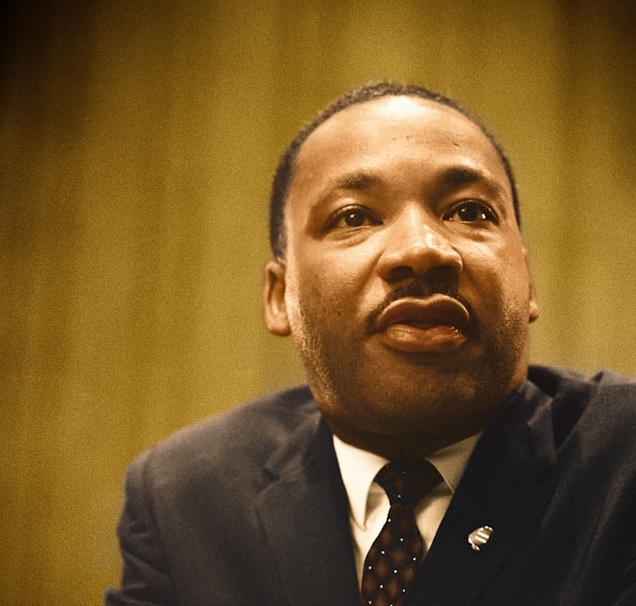
In the Episcopal Church the Feast of Martin Luther King, Jr., is celebrated on April 4, the date of his death.
One of the things that strikes me about the gospel assigned for that day (Luke 6:27-36) is just how much Jesus sounds like Martin Luther King, Jr.
“Love your enemies, do good to those who hate you, bless those who curse you, pray for those who abuse you. If anyone strikes you on the cheek, offer the other also.” (Luke 6:27)
That’s good stuff. It’s important stuff. It’s the kind of stuff that sits at the heart of King’s teachings and principles and practice of nonviolence. It is, I think, the stuff that began to shape and change his life. We see and hear that throughout his life.
There is so much that we see and hear about King’s life that is worth valuing, celebrating, and emulating. But today I want to talk about something in his life we often don’t see and hear about; the struggle within, that inner struggle to make sense of his life, his values, and the cost of confronting Pharaoh.
In 1955 shortly after the movement began, he talks about coming home one night from a meeting. He had already begun receiving death threats and obscene phone calls. He went into the house and looked at his newborn daughter as she slept and thought to himself, “I could lose her at any minute.” He went to the bedroom, saw his wife sleeping, and said to himself, “And I could lose her at any moment.” He sat at a table. He felt like he was faltering and his fear was growing. He was looking for a way out, but also one that would allow him to not look like a coward. He felt his courage leaking from his life. He felt weak. (Source)
I think that inner struggle and turmoil is what sits behind Moses’s question to God in the Old Testament reading assigned for King’s feast day (Exodus 3:7-12):
“Who am I that I should go to Pharaoh, and bring the Israelites out of Egypt?” (Exodus 3:11)
I think we all come to those moments when that’s our question too. They’re moments when we face up to who we are and who we’re not; moments when we recognize our fragility; and moments when we know ourselves to be called.
But maybe more importantly, they are moments when we must decide who we want to be and what really matters to us. They are moments when we have to decide if God is really real and whether we really believe that God will go with us?
Several years ago, a friend of mine was working to have the Confederate monuments removed from the front lawn of the Uvalde courthouse. He started a petition and scheduled a hearing with the County Commissioners. I dreaded my next conversation with him because I knew what he would ask.
The day came as I knew it would. The phone rang. It was him. I answered. “Mike, will you sign the petition and speak at the hearing?” I was torn and I was scared. I knew what they were saying about him, how they treated him, and the relationships he had lost.
I told him no, that I just couldn’t. “Who am I that I should go to Pharaoh?” For the next several days I sat in my self-betrayal. I lived with the betrayal of my priesthood and the gospel. Who had I become that I would not go to Pharaoh? Whoever it was I didn’t like him and it wasn’t who I wanted to be.
I called my friend back and told him I had changed my mind. We lost at the hearing, but maybe I won a small piece of myself back, maybe I had learned some things, maybe next time I’d answer differently.
“Who am I that I should go to Pharaoh?” It’s a threshold question. It’s the question we ask when we stand between God and Pharaoh; between the one who delivers and the one who oppresses. It’s where so many in Minneapolis and across America are standing today.
I don’t think it’s a one time question. Maybe it’s not a question that ever gets finally and forever answered. Maybe it’s a question we carry and we live with, a question we bring to each injustice.
Today it’s the question I hear echoing in my heart every time I read or hear the news. “Who am I that I should go to Pharaoh?” What can I do?
I wonder in what ways that’s your question today? What’s the struggle within you? Who or what is the Pharaoh that you’re confronting or being asked to confront?
One of the things I know is that we can never confront the Pharaohs in this world until we confront the Pharaoh within ourselves.
Sometimes that Pharaoh is our fear, intimidation, or concern about what others will say or think about us. Sometimes it’s apathy or indifference, or waiting for someone else to step up. Maybe it’s the fear of consequences, the price we’ll pay, the loss of relationships. That inner Pharaoh is whatever keeps us stuck, imprisons us, impoverishes us, and diminishes our life to nothing more than make a brick, make a brick, make a brick.
I don’t want to live that way and my guess is you don’t either. And if we’ve come to that moment – if we’ve come to that, “Who am I that I should go to Pharaoh?” kind of moment – then we’ve also met the Moses that lives within us. Every one of us is a Moses. And this country sure could use some Moseses. Maybe that’s you and me.
Do you remember what the name Moses means? It means drawn or taken from the water? Isn’t that who we really are? Aren’t we the ones who have been drawn and taken from the waters of baptism? Are we not the ones who have been drawn and taken from the waters of baptism to persevere in resisting evil, to seek and serve Christ and all persons, to love our neighbor as ourselves, to strive for justice and peace, to respect the dignity of every human being? (“The Baptismal Covenant,” The Book of Common Prayer, 304-305)
“Who am I that I should go to Pharaoh?” Who are you that you should go?
Behind that question lies another question: “What will happen to me if I go?”
That was my question when my friend asked me to sign the petition and speak at the Commissioners’ Court. My guess is that’s also a question Moses asked himself. I suspect it’s the question Martin Luther King, Jr., was struggling with that night.
I don’t know how King answered or made peace with that question. I wonder though if he asked a different question, a better question: “What will happen to them if I don’t go?” (Paraphrased from King, “On Being a Good Neighbor.”)
____________________
Image Credit: Photo by Unseen Histories on Unsplash.


 Interrupting the Silence
Leave a comment