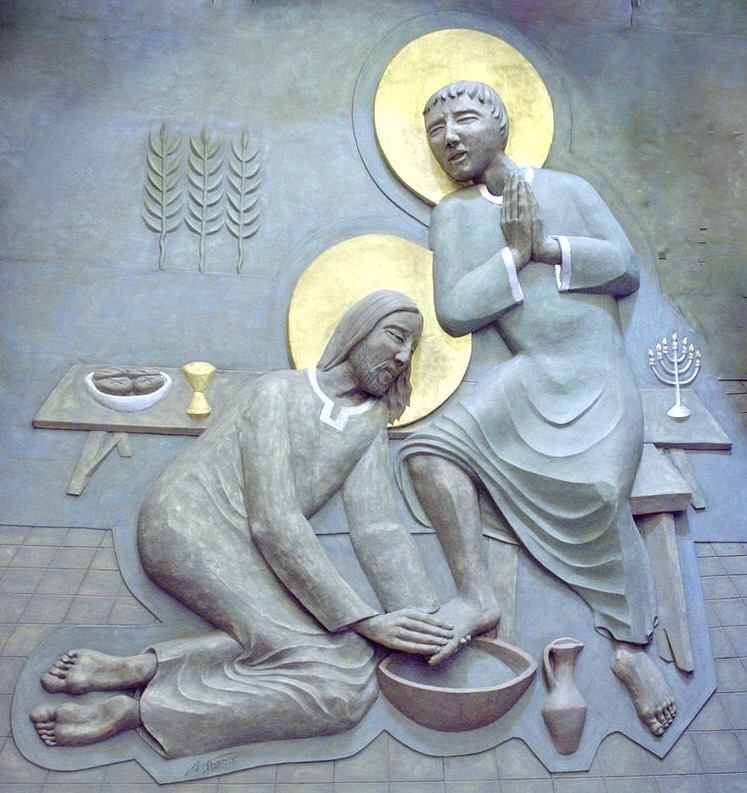
“I give you a new commandment, that you love one another” (John 13:34.), Jesus said after washing the feet of his disciples. (John 13:1-17, 31b-35)
So, what’s new about love? What makes this commandment, this love, new?
Love is not an idea original with or unique to Jesus and he wasn’t the first to command it. And loving others is not exclusive to the New Testament.
Speaking through Moses the Lord said to the people of Israel, “You shall love your neighbor as yourself” (Leviticus 19:18.), and “You shall love the alien as yourself.” (Leviticus 19:34. See also Deuteronomy 10:19.)
Jesus didn’t say, “I give you the same old commandment you’ve heard before, that you love one another.” Rather, he said, “I give you a new commandment.” So what’s different this time?
This new commandment to love is given in the context of the foot washing. It marks the start of what Beatrice Bruteau calls the Holy Thursday Revolution. (Beatrice Bruteau, The Grand Option, (Notre Dame: University of Notre Dame Press, 2001), 149.)
“Foot washing was a menial task ordinarily performed by a servant.” And it was a one way relationship. “Servants wash the feet of their lords. Lords do not wash the feet of their servants.” (Ibid.) Jesus is reversing the usual hierarchical ordering of life and relationships.
This foot washing kind of love transforms our world view and changes the structure of our relationships from domination to communion. (Ibid.) This is a love by which Jesus declares, “I do not accept the relationship of lord and servants at all. I will no longer call you servants, but friends.” (Ibid., 150; John 15:15.) This is a love that creates communion, reciprocity, and intimacy. This love is the antithesis of domination.
When Jesus knelt at the feet of his disciples he was protesting a world structured by hierarchy and domination. That means –
- The Lord is not greater than the disciple.
- The master is not greater than the servant.
- The teacher is not greater than the student.
- The man is not greater than the woman.
- The rich are not greater than the poor.
- The white are not greater than the black.
- The citizen is not greater than the immigrant.
- The president is not greater than the people.
That’s what’s new about this commandment to love.
The United States is polarized. There is a war in Iran. We see the animosity toward and scapegoating of immigrants. Racism and the wealth gap between rich and poor continue. These and a thousand other expressions of hurtful and destructive domination like them reveal and emphasize what is new, different, and urgent about this commandment.
In a world where love has such a hard time these days, everything about this kind of love is new.
I hope that one day this new love becomes so commonplace, familiar, and routine that eventually we know it as the same old kind of love we’ve always practiced. I hope that one day communion rather than domination will be the default relationship. For now, though, I suspect this kind of love will always be new. This means we have work to do.
“Just as I have loved you, you also should love one another,” Jesus said. He could have also said, “Just as I have protested a world structured by hierarchy and domination, so also should you.”
I wonder what that love and protest look like and mean in your life today. That’s what I’m asking myself as we move into the final days of Holy Week. It raises some painful questions and difficult choices.
- In what ways am I the beneficiary of a world structured by hierarchy and domination?
- How am I sustaining, contributing to, or even strengthening that system, whether knowingly or unknowingly?
- What am I willing to let go of or lose to love in this new way?
- How can I make my relationships more communion based and less domination based?
- Am I willing to kneel in protest and suffer for the sake of this new love and the world it might bring forth?
- What keeps from me from following the example that has been set for me?
What about you? How do you answer those questions?
___________________
Image Credit: By © José Luiz Bernardes Ribeiro, CC BY-SA 4.0, Wikimedia Commons.
 Interrupting the Silence
Leave a comment