Pentecost Makes us Capable of God

There are moments in each of our lives when we begin to hear a new language. It’s new yet echoes with familiarity. We know it through our deepest longings and desires. If fills us with hope, life, and peace. It lies hidden deep within us. It’s always been there but then one day we hear it in a new way, as if for the very first time. On that day we hear in our “native language.” It describes, reveals, and makes present the deeds of God’s power in our lives. That is the miracle and gift of Pentecost.

It happens when we fall in love and find our lover’s voice does not just communicate information but speaks presence, union, and oneness. It’s that day when all of creation speaks. The birds no longer chirp but sing a song we know. The wind doesn’t just blow through the trees but now whispers stories of our future. It happens when we discover our vocation and we know that we are living the life to which God has called us and a voice reassures us, saying, “This is your place.” It’s in moments of joy-filled creativity and we wonder, “Where did that come from? How did I do that?” It is the soft voice in the midst of sorrow and loss that says, “I am here. It won’t be easy but you will be ok,” and somehow we have the strength to get up and meet the next day. It is the voice of compassion that enables us to care for another. It is a word of encouragement that points the way, a word of truth that causes us to turn around, a word of peace we embody as a reconciled relationship.

These and a thousand others like them are the moments of Pentecost, moments when we know God is not just with us or around us but within us and we are somehow different; more real, more alive, more whole. These, however, are often not the story of Pentecost with which we are most familiar. Instead, we listen for a sound like the rush of a violent wind to come from heaven and fill our entire house. We look for divided tongues, as of fire, to appear and rest on us. We wait to speak in another language.

Sound, tongues, and languages are how St. Luke describes the day of Pentecost. They are the images we most often associate with Pentecost but they are not the story of Pentecost. We sometimes confuse the two, the images and the story. It’s easy to do because the images are so vivid, so powerful, so different from ordinary, every day life. With their power, however, comes danger.

The danger is that we look at these images but fail to see through them. We make the images literal, opaque, and closed rather than symbolic, transparent, and open. We allow the images to define and identify rather than point and invite. When that happens the images lose their power and purpose. They can take us nowhere and Pentecost becomes a single event in history; unique, limited, and seemingly unavailable to us. Sound, tongues, and languages are not the keepers of Pentecost. They are the pointers to Pentecost.

When we see through these images we find that Pentecost is happening in all times, all places, and all circumstances. We hear in our “native language.” We realize that Pentecost is not a sound like the rush of a violent wind. It is not divided tongues of fire. It is not speaking in other languages. In and of themselves sound, tongues, and languages have no significance. They are meaningless. Their meaning is found only in hearing.

Hearing is what “amazed and astonished” on the day of Pentecost. They were not amazed and astonished at the sound of wind, the flaming tongues, or the foreign languages. They were amazed and astonished, asking, “How is it that we hear, each of us, in our own native language?”

That means that Pentecost is more than sound, tongues, and languages. Those are just the images of Pentecost. I’m not suggesting the images of Pentecost are not real but that they are more real than we know. They are the gateway to our own story of Pentecost. They empower us to open ourselves to an invisible world, to cross old boundaries, to be a different way, and to live a new life. They make us “capable of God.” Ultimately, that’s what Pentecost is about, becoming “capable of God.” That is not our doing. It is the Holy Spirit’s doing. The Holy Spirit makes us each “capable of God.” It is unique and personal to each one of us.

If you want to know how you are being made “capable of God” then go to the places where you hear in your own “native language.” There you will hear the stories of God’s presence filling your life. They will be stories of love, hope, joy; stories of patience, gentleness, courage, and peace; stories of mercy, forgiveness, reconciliation; stories of wisdom, creativity, and wonder; stories of healing, life, and resurrection.

These stories can only be heard in our “native language” for that is the language of God. Each one describes the deeds of God’s power in our lives. They are the lived stories of our Pentecost, our being made “capable of God.”

+

This sermon was preached on the Feast of Pentecost and is based on Acts 2:1-21. The Litany to the Holy Spirit was part of the entrance procession for this celebration.

A Litany to the Holy Spirit

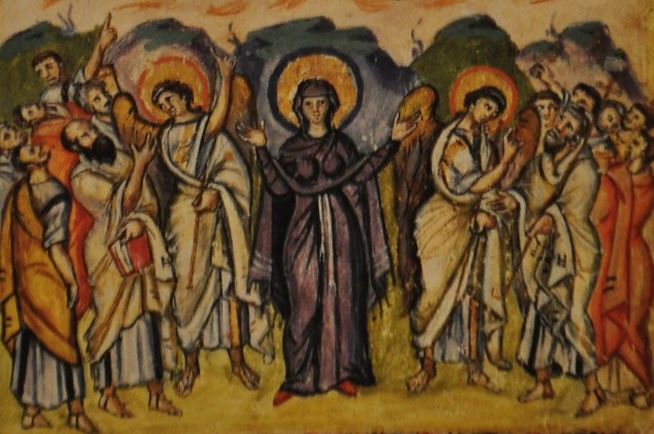
Icon of Pentecost

Descent of the Holy Spirit (source)

This Litany to the Holy Spirit was prepared using the traditional form of a litany. The contents of the litany are based on scripture, the Book of Common Prayer, and an Eastern Orthodox prayer to the Holy Spirit.

O God the Father, Creator of heaven and earth,
Have mercy upon us.

O God the Son, Redeemer of the world,
Have mercy upon us.

O God the Holy Spirit, Sanctifier of the faithful,
Have mercy upon us.

O holy, blessed, and glorious Trinity, one God,
Have mercy upon us.

Spirit, intercede for us with sighs too deep for words,
Pray for us.

Spirit, intercede for the saints according to the will of God,
Pray for us. Continue reading

God’s Conspiracy Gives Life

Jesus “breathed on them and said to them, ‘Receive the Holy Spirit’” (John 20:22).

Icon of the Theotokos

Icon of the Theotokos (source)

Recall a moment when you held another person so close that you could hear his or her breathing, the sound of life. Maybe it was your husband or wife, a parent, your child or grandchild, a dear friend. Cheek to cheek. You could feel his or her breath brush across your face and he or she felt yours. The two of you shared and breathed the same air. Giving and receiving. Breathing in. Breathing out. There was only one breath, one life, one love.

That was a moment of holy conspiracy. The intimacy of that conspiracy is beautifully shown in this icon of the Most Holy Theotokos. Mary cradles Jesus and pulls him close to her. Jesus’ left arm is on Mary’s shoulder. His right arm reaches around her neck pulling her face to his. They are cheek to cheek giving, receiving, and sharing the breath of life. They are coconspirators. Continue reading

Unity is a God-Entrusted Life, A Sermon on John 17:20-26

Be good. Take care of yourself. Have fun. Mind you manners. Work hard. Make good decisions. Learn a lot. Be careful. Call if you need something. Remember, I love you.

Those are the kind of things we say when we are leaving, departing. We give our last minute instructions for what the other should do after we have left. When I was growing up I heard some of these from my parents. I said some of these to Brandon when Cyndy and I would take him to church camp. I remember saying some of these to Randy before leaving him at the airport for his flight to Marine boot camp. I suspect each of you has said and heard these or similar words. They are our departing instructions to one we love. With those words we entrust the future well being of that loved one to himself or herself.

It would be easy to hear today’s gospel as Jesus’ departing instructions to his disciples. It would make sense. After all, it is the night of the last supper. Jesus knows he is leaving. He will soon be crucified and the disciples will have to find their way without his physical presence. So why not give some last minute instructions about how to act, what to do, the way they should treat each other? That’s what we might do but that is not what Jesus is doing. That is a misinterpretation of the text.

Jesus is not entrusting the future of the disciples to themselves. He is entrusting their future to God. His words are not departing instructions but a departing prayer. The disciples are God-entrusted not self-entrusted.

Today’s gospel is not a conversation between Jesus and the disciples but a prayer from Jesus to his Father, and our Father. Today we overhear Jesus’ prayer for us. His prayer isn’t for our benefit only but for the life of the world, so that the world may believe the Father sent Jesus. Our unity becomes the sacramental presence of God in the world. Our oneness continues the embodiment of God in human flesh and life.

Deesis-Mosaic-of-Christ-13th-Century-Hagia-Sophia1

This unity is not, however, something we do or create. Jesus does not tell the disciples to be nice to each other, to get along, to eliminate their differences, or to agree upon a common a plan or purpose. He doesn’t prescribe tolerance, uniformity, unanimity, or consensus. We are not the recipients of instructions but the subject and beneficiary of Jesus’ prayer.

Jesus prays three times for oneness. “That they may all be one.” “That they may be one.” “That they may become completely one.” The oneness for which he prays is modeled on the unity of the Father and Jesus, their shared life. He prays that we would be completely one as he and the Father are one. Jesus’ prayer echoes the ancient Jewish prayer, Shema Yisrael, “Hear, O Israel: the LORD is our God, the LORD is one (Deut. 6:4).

That Jesus is praying to the Father for our oneness, rather than giving instructions, means that unity is of and from God. It is not something we do or create. It is the very life and being of God. We do not establish unity, we participate in and manifest to the world the already existing oneness that is God.

This doesn’t mean we can just sit back and wait for God to answer Jesus’ prayer. We too have a part in answering Jesus’ prayer. Our oneness must take tangible and visible form if it is to show the world the invisible and spiritual life and presence of God. In some way our lives in relationship to God and one another become the answer to Jesus’ prayer.

Our lives and relationships are to be outward and visible signs of God’s inward and invisible presence. We can become and live this, however, only when we know ourselves to be God-entrusted rather than self-entrusted. That means our life comes not from ourselves but from God. That’s what allowed Jesus to choose the cross. That’s why he prayed rather than instructed. It’s how we become one as Jesus and the Father are one.

Right about now some instructions would be really helpful but I don’t have any. Jesus didn’t give any. There is no list. I can’t tell you what to do but I can tell you where to begin looking. This oneness exists at the intersection of our love for God and our love for each other. It is the intersection of the vertical axis and the horizontal axis. Unity is cross shaped. That point of intersection is, according to St. John’s account of the gospel, the hour of Christ’s glory, his death and resurrection. That is the preeminent image of a God-entrusted life. That’s where we find our oneness. That’s what we show the world.

Each time we live with a God-entrusted understanding of ourselves boundaries soften, divisions are not as deep, and relationships reconcile. Each time we take a step toward a God-entrusted understanding of ourselves and let go of a self-entrusted life we move towards oneness.

When, in love for God and each other, we surrender our self-entrusted life to a God-entrusted life we embody the Father’s answer to Jesus’ prayer and we are one as Jesus and the Father are one. In that moment we have, as a friend of mine says, “met the glory of God and it is us.”

+

This sermon is for the Seventh Sunday of Easter, Year C, and is based on John 17:20-26.

Ascension Day Blessing

May Almighty God enlighten the eyes of your heart to see that his blessed Son our Savior Jesus Christ ascended far above the heavens that he might fill all things. Amen.

May he who ascended into heaven prepare a place for you; that where he is you might also be, and reign with him in glory. Amen.

May you who believe that our Lord Jesus Christ ascended into heaven, also in heart and mind there ascend, and with him continually dwell. Amen.

And the blessing of God Almighty, the Father, the Son, and the Holy Spirit, be upon you and remain with you forever. Amen.

Icon Detail Ascension of Jesus

Ascension of Jesus (source)

Get Up Off Your Mat – A Sermon on John 5:1-9

Icon of Jesus and Man at Pool of BethzathaThirty-eight years is a long time to sit on your mat. Every day is the same. Waiting. Watching. Hoping. Not much changes. Sitting on his mat has become a way of life for the man in today’s gospel. His life is stagnant. He’s unable to see that the deep well of life is within him. He’s convinced that life will bubble up outside of him, over there, in that magic pool of water. So he sits on his mat waiting, watching, and hoping that things will change.

There was a belief that this pool of water called Beth-zatha had healing properties and that it could change one’s life. It was said that every now and then an angel would stir the water, the water would begin to bubble, and the first one in the water would be healed. The man in today’s gospel won’t get up off his mat until he sees the first bubble. He is living an “as soon as” life.

“As soon as the water bubbles then I will get up off my mat. As soon as I get to the water my life will be better. As soon as I get into the water my problems will be fixed.” Continue reading