Today’s gospel (Mark 9:2-9), the story of the transfiguration, is one of those big stories from scripture. It’s a mountaintop experience of dazzling white clothes, Elijah and Moses talking with Jesus, and a cloud from which God speaks.
It’s such a big story that it can easily feel a bit too fantastical, too unreal, and too far removed from real life to have any meaning for us. And yet, it’s one of the few gospel stories, maybe even the only one, that shows up twice in our lectionary every year which suggests it’s pretty important and we ought to pay attention to it.
I wonder where this story fits in your life. Does it have a place? What does it mean for your life today?
My guess is that for most of us the point of this story is what Peter, James, and John see. They see Jesus transfigured. That’s often how I’ve heard this story.
But what if this story is less about what they see and more about how they see? What if Jesus didn’t suddenly change and light up before them but they saw for the first time what had always been before them? What if the transfiguration isn’t about Jesus’ new clothes but their new eyes?
Maybe this story is offering us a different way of seeing and living.
“There are only two ways to live your life. One is as though nothing is a miracle. The other is as though everything is a miracle.”
Albert Einstein said that. I think he is describing two ways of seeing, two ways of engaging life and the world. It’s not so much about what we see but about how we see.

How we see usually determines what we see. I wonder if that’s what allowed Peter, James, and John to see Jesus transfigured. Maybe it was their way of seeing that changed and not Jesus. So I’m going to borrow Einstein’s words and adapt them to fit today’s gospel.
There are only two ways to live your life. One is as though nothing is transfigured. The other is as though everything is transfigured.
If nothing is transfigured then what you see is what you get. Life is mundane. There is nothing new to see. We’ve already seen it all. We live life on the surface. There’s no depth and no mountain top. We’re flat people, living flat lives, in a flat land. Life is one dimensional.
But if everything is transfigured we live with a sense of awe, wonder, and gratitude. Everything is alive and in motion. Everything attracts our attention and curiosity. We open ourselves to new discoveries. We live with expectancy knowing that there is always more to be seen. We become people of depth and life is multidimensional.
I don’t know if this works or makes sense but maybe we could think about it as the difference between looking at a window and looking through a window.
When I look at the window I lose sight of what’s really going on. My world is small and usually rectangular. My vision is myopic. I don’t see beyond what is right in front of me. There’s no depth, no mystery.
But when I look through a window my world is larger. It has width, height, and depth. It invites me in. I see life and movement. I see both the beauty of the world and the pain of the world each asking for my presence, each calling me to respond. I connect to something larger than and beyond myself.
Or maybe it’s like the difference between staring at something and seeing with soft eyes. You’ve probably felt the difference between those two. How does it feel when someone stares at you? It’s uncomfortable. Staring eyes are sharp, hard, and narrow. Compare that to a time when someone saw you with soft eyes. Soft eyes are welcoming, receptive, inviting.
How’s your vision these days? Are you looking at the window of your life or through the window of your life? Are you seeing with staring eyes or with soft eyes? Is nothing transfigured or is everything transfigured?
Take, for example, the offertory. Is it just bread, wine, and money? Or do you see more? Do you see only the bread and wine or do you see the wheat, grapes, soil, sunshine, rain, pollinators, farmers and field workers, bakers and wine makers? All that and more is contained in the bread and wine. Do you see only checks and dollar bills in the offertory plate or do you see people’s lives, gifts and abilities, time, sacrifices, exhaustion, busyness, work, passions, energy, and sweat?
When you look at another person do you see only where they are from, what they believe, or what they have done and left undone? Or do you see another human being with fears, wounds, and losses as real as yours, and needs, hopes, and dreams as valid as yours?
One of my favorite pictures is of me holding my younger son. He’s about three years old. He has his hands around my neck and his forehead pressed against mine. We’re face to face, nose to nose, eye to eye.
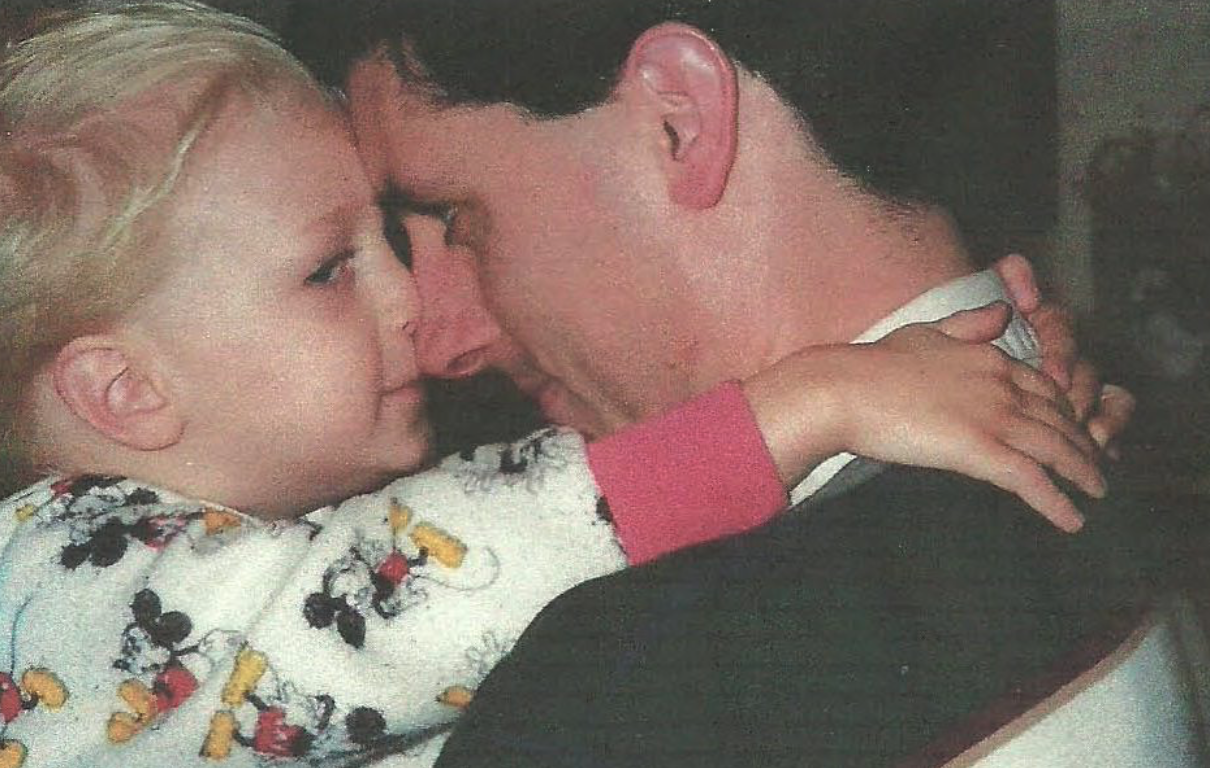
That moment is transfigured. It holds everything. It is, however, more than just a father and son. The old adage, what you see is what you get, is not always accurate. We are a part of something much larger than ourselves. There is a presence greater than just the two of us. There is more going on than what physical eyes can see or understand. It’s a moment that cannot be explained or described, only experienced.
When have you experienced that kind of moment? When have you seen more than what you were looking at? When have you felt yourself connected to something larger than and beyond yourself? When have you experienced a presence greater than your own? That’s transfiguration.
What would it be like to live that way every day? What if we could see and experience transfiguration everywhere we went, in everyone and everything we saw, in everything we did? What if transfiguration already is the reality, always has been, and always will be?
Maybe that’s why every year on this day, the Last Sunday after the Epiphany, we always hear the story of the transfiguration. It’s our entry into Lent. And Lent is a season of correcting our vision, learning to see with soft eyes, and once again discovering that life is already transfigured.
A few days ago someone told me he got his first pair of glasses when he was eight years old. He told his mom that he could see leaves. She said, You’ve never seen leaves before?” “No,” he said.
It wasn’t the leaves that had changed, it was his seeing. The leaves of transfiguration are everywhere for those who have eyes to see.
I want those eyes, don’t you?
How is your seeing these days? Is it in need of healing? Does your vision need correcting? What keeps you from seeing transfiguration in yourself, another, the world? What would help you live as though everything is transfigured?
Take another look. I wonder what is coming into focus for you.
____________________
Image Credit: Photo #1 by Josie Weiss on Unsplash.

 Interrupting the Silence
Leave a comment