Author Archives: marshmk

A Lived Amen – A Sermon on John 17:6-19; Easter 7B

The collect and readings for the Seventh Sunday of Easter may be found here. The following sermon is based on John 17:6-19.

“Protect them from the evil one,” Jesus prays.

We live in a dangerous world. I’m not telling you anything you don’t already know. We read about the dangers of this world every day. We see the pictures on the internet and the daily news. Some of you have experienced first hand the dangers of life.

The human instinct to danger is fight or flight. Neither one, however, really changes the situation. One adds to violence and increases the danger. Someone will get hurt, life will be lost.  The other creates and opens a space and a place for the danger to exist. Again, someone will get hurt, life will be lost. The events and circumstances that we perceive as dangerous are real but they really just point to deeper issues. They are symptoms of what is going on within the human heart. They reveal the wounds and brokenness that often stand in opposition to the life, love, and ways of God. This opposition is what St. John means by “the world.”

John is not talking about the created order, nature. That was created good and remains so. The world refers to the many different operating systems that we use, and have come to accept as normal, to order human life: our social, cultural, political, and economic structures. Far too often those systems both arise from and create fear, anger, division, injustice, and greed. That is the world into which Jesus sent his disciples and it remains the world in which we live and practice our faith.

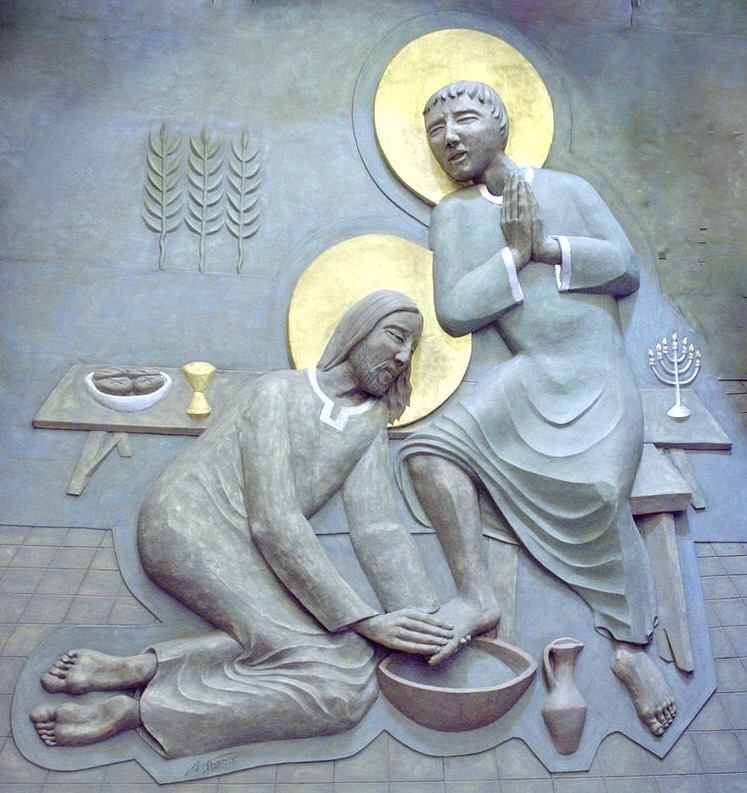
Jesus knows that the human ordering of life is often contrary and even opposed to God’s ordering of life. That concern is the subject of his prayer in today’s gospel. It is the evening of the last supper. Feet have been washed. Supper is ended. The betrayer has left and it is night. The darkness has descended: the darkness of Jesus’ impending death, the darkness of not knowing the way, and the darkness of the world.

Jesus neither runs from nor fights the danger of the world. He offers a different way. He loves and prays. He lays down his life in love. He prays for us, the ones who will continue his life and work in the world. We live in the world but we do not belong to it. We belong to Jesus and the Father.

The great danger for us is that the darkness will invade, fill, and overtake our hearts. We either give up or buy in to business as usual. You hear that in phrases like, “What can I do? I am only one person” or “That’s just how it is. It’s always been like that.” Jesus’ prayer, however, suggests that is not how it is intended to be and it doesn’t have to continue that way.

Jesus prays that his joy may be made complete in us. This happens in the midst of the world and its dangers. It is neither running away from the systems of the world nor standing up to them but laying down life before them in witness to Christ’s love. That’s not easy to do. Jesus does not pray that it would be easy or that we would be taken out of the world. Instead, he prays for our protection in the world. Live the amen.

Our protection is not found in escaping or avoiding the danger. The protection Jesus asks for us comes through sanctification. “Sanctify them in the truth; your word is truth,” Jesus prays.

Sanctification separates us from the usual operating systems of the world. We neither give up nor buy in. Instead, our lives are transformed. We live according to and reveal God’s system for the world: things like love, mercy, forgiveness, beauty, wisdom, generosity. Our protection is in being made holy and wholly God’s. That is what keeps us safe in the midst of the conflict.

It is not enough to just hear Jesus’ prayer. His words ask that we live, act, and work with God in answering his prayer. We are to actively participate in Jesus’ prayer by shaping our life to be increasingly like his. So while we might give an “amen” to Jesus’ prayer we must also examine our own hearts and ask ourselves some hard questions.

The real issue is not about what’s out there in the world but about what’s in here, in our hearts. What is our hearts’ orientation? How do we benefit from, participate in, and foster the systems of the world that oppose God’s life? Are we willing to change? Do we operate out of our wounds and brokenness: resentments, the need to win, looking out for number one, living with an attitude or scarcity, prejudice, fear, self-condemnation or hatred? To the degree we do, we deny God our life and contribute to the darkness of the world. That is not God’s desire or hope for our lives or the world.

You, I, and all humanity are worth so much more than that. Jesus’ own life and prayer declare that. We are the gift he and his Father share and exchange between themselves. Jesus entrusts us to his Father’s protection even as he entrusted himself to the Father. To do anything less denies us God’s sanctification, our protection.

“Holy Father, protect them,” Jesus prays. In large part the answer to Jesus’ prayer rests in our hands, our hearts, and our “amen,” not just a spoken amen but a lived amen.

Live the amen. Offer forgiveness rather than retribution, mercy instead of condemnation, and compassion rather than indifference. Lay down your life in love for another. See life through the lens of beauty and not cynicism. Choose unity over individualism and God’s ways over personal agendas. In those moments you are the amen to Jesus’ prayer, your heart is healed, and the world is different.

“Why do you stand looking up to heaven?” – A Sermon for the Feast of the Ascension

The collect and readings for the Feast of the Ascension may be found here. The following sermon is based on Acts 1:1-11 and Luke 24:44-53.

We live in a world in which up is better than down. Singers want to be at the top of the charts, athletes want to be on top of their game, and students want to be at the top of the class. Everyone would rather have an up day than a down day. When the stock market rises we celebrate but despair when it crashes down. No one wants to be at the bottom of someone’s list. We work to climb, not to descend the career ladder. We hear and read about mountain climbers but not much is said or written about valley descenders. Recently, the three year old class at our parish school has delighted in showing me how high they can jump and, at least for a moment, defy gravity.

The reality is that we want to live ascended lives. We want to break free from the things that hold us down and rise above it all. There’s nothing wrong with that. In fact, it is right. Something within us knows that we are more than earthbound creatures. The problem is that we have distorted what ascension and an ascended life mean. We forget, or perhaps deny, that Christ’s ascension seats humanity next to God, and settle for attempted self-ascension.

That distortion has invaded our theology and understanding of God. In this distorted view God, heaven, and holiness are up there somewhere while we are stuck down here. So we spend our time jumping up and down like little children thinking if we jump hard enough, high enough, and fast enough we can touch the moon. This gets lived out in so many ways. It almost always involves comparison, competition, and judgment of some kind. We compare ourselves and our lives with other people and their lives. We compete with each other believing that for us to ascend the other has to descend or at least not jump as high as us. We are forever judging ourselves and one another. We fill our lives with busyness hoping to climb to new heights. A life of self-ascension keeps us always searching for the next high.

Our attempts at self-ascension fragment our world and our lives. They separate the creature from the creator. They destroy relationships and intimacy. Ultimately, they become the gravity that deny us the ascended life we are seeking, a life that, in reality, is already ours.

Jesus’ ascension reshapes our disfigured understanding of an ascended life. His ascension is the corrective and antidote to the fragmentation and separation of self-ascension. His is the only authentic and life-giving ascension. Through him we too can live ascended lives.

Jesus’ ascension is not about his absence but about his presence. It is not about his leaving but about “the fullness of him who fills all in all.” It is not about a location but about a relationship. Presence, fullness, and relationship must surely be what lie behind the question of the men in white, “Why do you stand looking up to heaven?” It is as if they are saying to us, “Don’t misunderstand and disfigure this moment. Don’t deny yourselves the gift that is being given you.”

The ascension of Jesus completes the resurrection. The resurrection is victory over death. The ascension, however, lifts humanity up to heaven. Jesus’ ascension seats human flesh, your flesh and my flesh, at the right hand of God the Father. We now partake of God’s glory and divinity.

The ascension is more about letting go than it is reaching and grasping. The question for us is not, “How do we ascend?” That has already been accomplished. The question is: “What pulls us down?”

What do we need to let go of? Fear, anger, or resentment often weigh us down. The need to be right or be in control is a heavy burden. For some self-righteousness, jealously, or pride is their gravity. Many of us will be caught in the chains of perfectionism and the need to prove we are enough. For others it may be indifference or apathy. Far too many lives are tethered by addiction.  Gravity takes many forms and I wonder, what is the gravity that denies you Jesus’ ascension?

The gravity that keeps us down is not creation or the circumstances of our lives. Gravity is not around us but within us. So as you begin to look at your life and identify the places of gravity, do not despair. The very things that hold us down also point the way to ascension. Our participation in Jesus’ ascension begins not by looking up but by looking within.

Candy Wrappers and the Love of Christ – A Sermon on John 15:9-17; Easter 6B

The collect and readings for the Sixth Sunday of Easter may be found here. The following sermon is based on John 15:9-17.

The summer before my fourth grade year we moved to my mom’s hometown where we would live while my dad was in Viet Nam. The day before he left we drove to Kansas City and spent the night at the Holiday Inn near the airport. The next day we went to the airport. Back then families could go to the gate. On the way to the gate my dad stopped at one of the little shops and bought me a York Peppermint Patty. I ate the candy and carefully folded the wrapper and put it in my pocket. I had to keep it. I believed that somehow it carried his presence. It was his gift to me, the last thing he touched, and my connection to him.

At a deeper level, holding on to that foil wrapper revealed my desire to be connected, to be remembered, to have and to know my place in life. We all want that. Regardless of how old we are or the circumstances of our lives we want to know: Who am I? What are the connections that will sustain my life? Where is my place in this world?

Those are the questions Jesus is addressing as he speaks to his disciples in today’s gospel. It is the evening of the last supper. Jesus is speaking final words, one last sermon, to his disciples. He is preparing them for life without his physical presence, foreshadowing what resurrected life, Easter life, is to be like. He offers some direct answers to those questions: You are my friends. Abiding love, laying down life kind of love, is the connection that will sustain you. I am your place in this world.

Most of us spend a lifetime searching for those answers and trying to make them our own. They must, however, become more than intellectual answers. They must become lived answers. We learn to trust and live those answers in relationship with one another. Life is a school for learning to love. Death is a school for learning to live.

Our searching for those answers is ultimately our searching for Christ. That searching is always there but it becomes more acute in times of change: the death of a loved one, kids growing up and moving out, a new job, retirement, a debilitating illness, a move to a new town, a marriage or a divorce. In those moments we want something to hold on to, something to comfort, encourage, and reassure us; a candy wrapper that will guide us through life.

About ten years ago I was talking with my dad about his year in Viet Nam. I told him about the candy wrapper. As I told the story I realized in a new way that the candy wrapper was not the gift, the thing that carried his presence. I was. I was the last thing he touched when he hugged and kissed me. I was the one to whom he gave last minute instructions, “You are now the man of the house. Take care of your mom and sister.” I was the one who received his words, “I love you.” My life, my actions, my very being somehow carried his presence and our shared love. The connection was and always had been within me not a foil candy wrapper.

Sadness, fear, and desperation often cause us to grasp for candy wrappers in one form or another. We stuff them into our pockets and purses hoping and trying to create a connection that already exists, maintain a presence that is already eternal, and hang on to a love that is already immortal. We do this not only with one another but also with Christ. With each candy wrapper we collect we forget or maybe even deny that our lives embody the shared and mutual love of Christ and one another. In that love is the fullness of presence; a presence, the disciples will learn, that transcends time, distance, and even death.

At some point we must throw away the candy wrappers we hold on to so that we can hear, experience, and live the deeper truth. Our lives, our actions, our love carry and reveal the presence of divine love. Jesus does not give us something, he says we are something. We are the gift. We are the connection. Listen to what he tells the disciples:

  • I love you with the same love that the Father loves me. You have what I have.
  • I give to you the joy that my Father and I share. You are a part of us.
  • You are my joy, my life, and my purpose.
  • I want your joy to be full, complete, whole, and perfect.
  • You are my friends, my peers, my equals.
  • I have told you everything. Nothing is held back or kept secret.
  • I chose you. I picked you. I wanted you.
  • I appointed, ordained, commissioned, and sent you to bear fruit, to love another. I trust and believe you can do this.

It’s all about us in the best sense of those words. We are the love of Christ. Our belief in Jesus’ words changes how we see ourselves, one another, the world, and the circumstances of our lives. That belief is what allows us to keep his commandment to love one another. When we know these things about ourselves our only response is love. We can do nothing else. We are free to live and more fully become the love of Christ.

The challenge of our search is not to find the answers but to believe and live them. Who are we? The love of Christ. What are the connections that will sustain our lives? The love of Christ. Where is my place in this world? The love of Christ. In, by, with, and through the love of Christ “all shall be well, all shall be well, every manner of thing shall be well.” (Julian of Norwich)

Tell the Story

Elie Wiesel tells the following story in his book, The Gates of the Forest:

When the great Rabbi Israel Baal Shem-Tov saw misfortune threatening the Jews it was his custom to go into a certain part of the forest to meditate. There he would light a fire, say a special prayer, and the miracle would be accomplished and the misfortune averted.

Later, when his disciple, the celebrated Magid of Mezricth, had occasion, for the same reason, to intercede with heaven, he would go to the same place in the forest and say: “Master of the Universe, listen! I do not know how to light the fire, but I am still able to say the prayer.” And again the miracle would be accomplished.

Still later, Rabbi Moshe-Lieb of Sasov, in order to save his people once more, would go into the forest and say: “I do not know how to light the fire, I do not know the prayer, but I know the place and that must be sufficient.” It was sufficient and the miracle was accomplished.

Then it fell to Rabbi Israel of Rizhyn to overcome misfortune. Sitting in his armchair, his head in his hands, he spoke to God: “I am unable to light the fire and I do not know the prayer; I cannot even find the place in the forest. All I can do is to tell the story, and that must be sufficient.” And it was sufficient.

Sometimes we know where to go, what to do, what to say. Other times we do not. The circumstances of life leave us feeling lost, incapable, and speechless. In those moments we can only tell and trust the story of those who have gone before us. Somehow, in telling the story we re-member those who have gone before and we make present their actions and prayers. The story transcends time and space. It unites them to us here and now. Their actions and prayers become ours through the faithful telling of the story; and it is sufficient.

Quotations from St. Julian of Norwich.

Today, May 8, is the Feast of St. Julian of Norwich. When Julian was thirty years old she became  gravely ill and was given last rites. On the seventh day of her illness, all pain left her, and she had a series of fifteen vision of our Lord’s passion. She recorded these in a book entitled Revelations of Divine Love or as Julian called it, Showings. The following quotations are taken from her writings:

 I saw that [our Lord] is to us everything which is good and comforting for our help. He is our clothing, who wraps and enfolds us for love, embraces us and shelters us, surrounds us for his love, which is so tender that he may never desert us. And so in this sight I saw that he is everything which is good, as I understand.

And in this he showed me something small, no bigger than a hazelnut, lying in the palm of my hand….

In this little thing I saw three properties. The first is that God made it, the second is that God loves it, the third is that God preserves it. But what did I see in it? It is that God is the creator and protector and the lover. For until I am substantially united to him, I can never have perfect rest or true happiness, until, that is, I am so attached to him that there can be no created thing between my God and me.

- The Fifth Chapter

Sin is necessary, but all will be well, and all will be well, and every kind of thing will be well.

- The Twenty-seventh Chapter

And so our good Lord answered to all the questions and doubts which I could raise, saying most comfortingly: I may make all things well, and I shall make all things well, and I will make all things well; and you will see yourself that every kind of thing will be well.

- The Thirty-first Chapter

For I saw most truly that where our Lord appears, peace is received and wrath has no place; for I saw no kind of wrath in God, neither briefly, nor for long.

- The Forty-ninth Chapter

And I saw no difference between God and our substance, but, as it were, all God; and still my understanding accepted that our substance is in God, that is to say that God is God, and our substance is a creature in God. For the almighty truth of the Trinity is our Father, for he made us and he keeps us in him. And the deep wisdom of the Trinity is our Mother, in whom we are enclosed. And the high goodness of the Trinity is our Lord, and in him we are enclosed and he in us. We are enclosed in the Father, and we are enclosed in the Son, and we are enclosed in the Holy Spirit. And the Father is enclosed in us, the Son is enclosed in us, and the Holy Spirit is enclosed in us, almighty, all wisdom and  goodness, one God, one Lord.

- The Fifty-fourth Chapter

I was answered in spiritual understanding, and it was said: What, do you wish to know your Lord’s meaning in this thing? Know it well, love was his meaning. Who reveals it to you? Love. What did he reveal you? Love. Why does he reveal it to you? For Love…. So I was taught that love is our Lord’s meaning.

- The Eighty-sixth Chapter